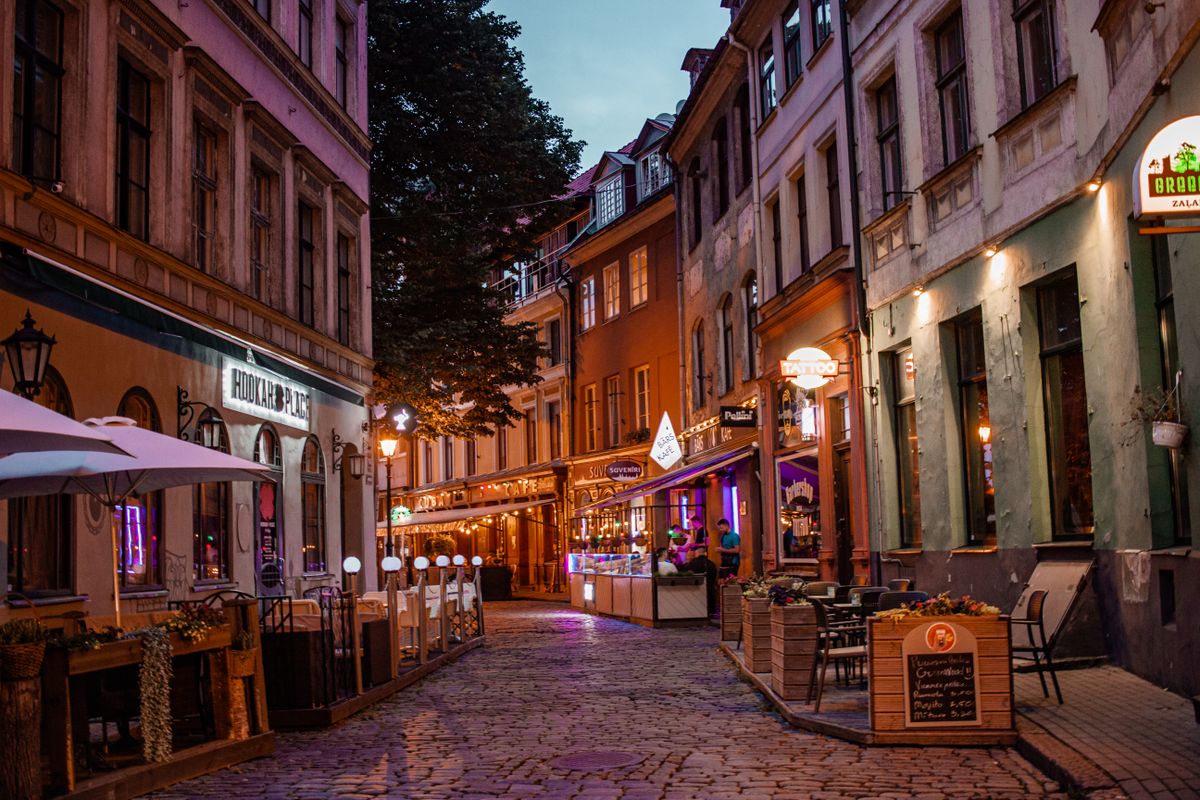
Every city has one street it points to when it wants to look good, and Chicago's is Clark Street in Andersonville. The stretch between Foster and Bryn Mawr packs Swedish heritage, a legendary beer bar, some of the city's best brunch, and a small army of independent shops into a walk you can do in fifteen minutes but should stretch over an afternoon. Consider this our field guide to Andersonville restaurants, drinks included, with a Swedish history lesson thrown in for free.
Clark Street, the Friendliest Strip in Town
Andersonville sits on the far North Side, a former Swedish farming settlement that became the heart of Swedish Chicago by the early twentieth century. The water tower painted in Swedish blue and yellow above Clark Street has been the neighborhood's landmark for generations, and the Swedish American Museum below it anchors the strip, a small institution that takes its herring seriously and runs a genuinely charming children's museum upstairs.
What makes the street work today is a stubborn commitment to independent business. Chains are rare. The storefronts turn over slowly. The people behind the counters tend to own the place or know who does. That texture is why Andersonville routinely lands on those national lists of great neighborhood streets, and for once the lists are right. It is also, not incidentally, one of Chicago's proudest LGBTQ+ neighborhoods, a legacy that grew as the community migrated north from Lakeview over the decades and that gives the strip its easygoing, everyone-welcome temperature. Come in August and the sidewalk tables run the length of the street, which is Clark at its best.
The Swedish Heritage Table
Start with the old country. For decades the neighborhood's Swedish kitchens fed Chicago pancakes with lingonberries, meatballs with cream gravy, and falukorv to homesick Swedes and adopted ones alike; Svea, the tiny diner that long held down the strip's Swedish breakfast tradition, is remembered fondly by everyone who ever squeezed into it, and the Swedish American Museum's shop still stocks the pantry staples for home attempts. The herring, the crispbread, the cloudberry preserves: the ingredients of the neighborhood's first century remain within reach even as the dining scene around them has broadened.
The living, pouring monument to that heritage is Simon's Tavern, of which more below, because it deserves its own chapter. Suffice to say that no visit to Andersonville is complete without paying respects to the fish sign on Clark Street. And if the heritage angle grabs you, time your visit to the museum's calendar: between holiday markets, cooking demonstrations and the annual festivities around Midsommar, there are several chances a year to eat your way through the old country without a passport.
Simon's Tavern and the Glogg Question
Simon's Tavern has been serving the neighborhood since the 1930s, a Prohibition-vintage bar with a nautical interior, a storied basement, and a history of cashing paychecks for Swedish tradesmen back when banks kept inconvenient hours. Its signature is glogg, the spiced Swedish mulled wine, ladled out in cold months and famously offered in a frozen slushy form when the weather turns warm, a move we can only describe as heroic.
It is a bar where the history is not decoration; it is load-bearing. Sit at the bar, order accordingly, and ask about the neon fish out front. Someone will tell you the story, and the story is good. In August the glogg goes into its frozen summer costume, the jukebox earns its keep, and the room stays cool and dim while Clark Street bakes outside. There are flashier bars in this city. There are no better ones.
Andersonville's genius is scale. Nothing on Clark Street is trying to be the biggest anything. It is all just trying to be good, and most of it is.
Brunch: Where the Lines Come From
If you see a cluster of people on a Clark Street corner on a Sunday morning, you have found the brunch scene. The standard-bearer is m.henry, the daytime cafe whose blackberry bliss cakes have been photographed more than some celebrities and whose weekend waits are a neighborhood institution in themselves. It is warm, it is generous, and it is exactly what a neighborhood brunch room should be.
The strip supports a full rotation of daytime options beyond it, from diner-style standbys to pastry-forward cafes, and competition keeps everyone honest. We maintain a running city-wide ranking in our guide to the best brunch in Chicago, and Andersonville is one of the few neighborhoods with multiple entries in contention at any given time. Strategy for visitors: put your name in, then browse the shops. Clark Street was built for exactly this kind of productive waiting.
Hopleaf, the Anchor
Every great dining street needs an anchor, and Andersonville's is Hopleaf. Michael and Louise Roper's Belgian-leaning beer bar has been the standard against which Chicago beer bars are measured since 1992: hundreds of bottles, a draft list curated with scholarly seriousness, and a kitchen that made mussels and frites a North Side food group. The CB&J, their cashew butter, fig jam and cheese sandwich, is the rare bar sandwich with a fan base that crosses state lines.
It is a grown-up bar in the best sense: no televisions, conversation-friendly, kids welcome in the dining rooms but the barroom kept for the adults. On a summer evening, settling into the back atrium with a lambic and a pot of mussels is as close to Belgium as Chicago gets. Expect a wait on weekends. Join it. This is not a controversial recommendation; it is a rite of passage.
Date Night and the Sit-Down Rooms
For proper dinners, Clark Street punches well above its weight. Anteprima has long been the neighborhood's Italian standby, a candlelit room doing seasonal cooking with quiet confidence, and the strip's rotation of Mediterranean, Middle Eastern and contemporary American rooms keeps date-night options deep without ever feeling like a scene. This is the neighborhood's dining signature: rooms built for conversation, menus built for sharing, prices that leave money for the bookstore afterward.
A word on strategy for the indecisive: walk the strip once from Foster to Bryn Mawr before committing. Menus are posted, hosts are friendly, and the fifteen-minute reconnaissance lap doubles as an appetite builder. Unlike downtown, where a wrong choice costs you real money, the stakes here are pleasantly low; the floor of quality on Clark Street is high enough that even your backup plan tends to work out. We have been "settling" for second choices in Andersonville for years and have yet to regret one.
Casual appetites are covered too. The strip and its side streets hold solid pizza, generous diner plates, and enough comfort food to survive a Chicago winter, though when the craving turns specifically to smashed patties and griddled onions we tend to consult our own ranking of the best burgers in the city and make a plan. Andersonville is many things, but it is above all a neighborhood where eating well requires no reservations, no planning, and no second mortgage.
Bakeries, Provisions and the Take-Home Game
Lost Larson is the modern face of the neighborhood's Scandinavian sweet tooth, a bakery where cardamom buns and immaculate laminated pastry meet serious bread baking, and the morning line moves with impressive purpose. A few blocks away, Middle East Bakery & Grocery has been an Andersonville institution for decades, beloved for fresh pita, house-made spreads, spices in bulk and a prepared-food counter that has stocked half the neighborhood's picnics. Between those two and the chocolate shops and cheese counters scattered along Clark, you can assemble a world-class picnic in twenty minutes.
Take it two blocks east and you are in the parks along the lakefront soon enough, or simply claim a bench and watch the street go by. In late August, with the light going gold by early evening, this is one of the city's simplest pleasures.
Festival Season and the Sidewalk Months
Andersonville's calendar peaks in summer. Midsommarfest, the neighborhood's Swedish-rooted street festival held each June, is one of the city's oldest and best loved, closing Clark Street for a weekend of music stages, dancing around the maypole and general good-natured chaos; if your travel dates are flexible, it is worth planning around. Later in the season the neighborhood keeps the momentum going with sidewalk sales, arts events and the general institution of Clark Street patio life, which by August has reached its fully evolved form.
Even without a festival, weekends here have a low-key event quality: sidewalk tables full by noon, dogs of every size conducting their own social calendar, and a procession of ice cream cones heading north as the evening cools. Visiting in late summer means catching the neighborhood at its most expansive, and we recommend building in an unscheduled hour to do nothing in particular. Andersonville is unusually good at nothing in particular.
Winter visitors, do not be discouraged. The strip leans into the Scandinavian idea of coziness with conviction, from candlelit dinner rooms to glogg at Simon's, and a snowy Clark Street evening has its own devoted fan club, us included.
Do: Bookstores, the Museum and a Proper Wander
Between meals, Andersonville browses beautifully. Women & Children First, one of the country's great feminist bookstores, has been a neighborhood cornerstone for decades and programs readings that draw authors you have heard of into a room the size of a living room. The Swedish American Museum merits an unhurried hour, the antique and design shops along Clark reward aimless poking, and the residential side streets, all greystones and gardens, are an architecture stroll in themselves.
The comparison we keep reaching for is that Andersonville does for a lazy Saturday what Halsted Street's Greek strip does for a big group dinner; the two neighborhoods bookend the city's dining personality, and our guide to Greektown covers the southern end of that argument. One is a street you settle into; the other is a street you celebrate on. A complete Chicago education requires both.
Getting There: Red Line, and the Argyle Bonus
The Red Line does the work. The Berwyn stop drops you at the north end of the strip and Bryn Mawr serves it nearly as well; from either, Clark Street is a short walk west. The 22 Clark bus runs the length of the street itself and is the scenic local option. Driving is possible but Clark Street parking on weekends tests the spirit; the train spares you all of it.
Here is the move that turns a good day into a great one: get off instead at Argyle, one stop south of Berwyn, and start with a bowl of pho or a banh mi on the Vietnamese strip that has flourished around that station for decades, with Sun Wah BBQ and its famous duck as the headliner and Ba Le's sandwiches as the perfect walking fuel. Then stroll the fifteen minutes northwest into Andersonville for dessert, drinks and browsing. Two of Chicago's best food streets, one train stop apart, one unbeatable afternoon.
FAQ: Visiting Andersonville
How much time should I plan for Andersonville?
A half day is the sweet spot. Brunch or a bakery run, an hour of shopping and museum time, then drinks and dinner covers the strip without rushing. The neighborhood rewards lingering more than sprinting, so if you only have two hours, pick one meal and one stretch of Clark Street rather than trying to see everything.
Is Andersonville family-friendly?
Very. The Swedish American Museum runs a children's museum, most restaurants on the strip welcome kids, and the sidewalks are stroller-easy. Hopleaf keeps its barroom adults-only but seats families in the dining rooms. Weekend mornings are the most family-dense hours; evenings skew more toward date-night couples and groups of friends.
What is the best season to visit?
Late summer is prime: sidewalk cafes in full swing, long evenings, and the street festivals that punctuate the season. That said, Andersonville plays a strong winter game too, with cozy rooms, bakery warmth and Simon's glogg at full power. If you want the sidewalk-table version of the neighborhood, aim for June through September.