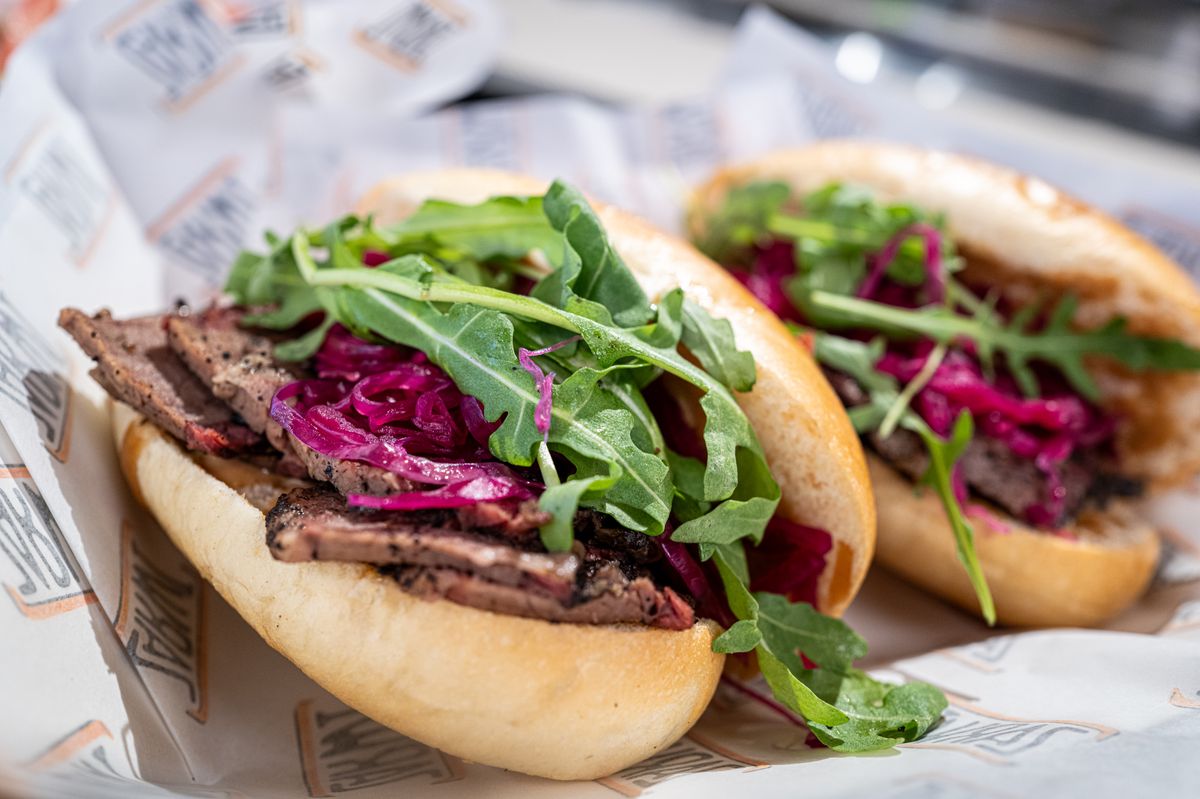
There is a sandwich in this city that requires a stance, a vocabulary, and a willingness to ruin your shirt. Italian beef in Chicago is not lunch; it is a belief system with napkins. Thin-sliced roast beef, jus-soaked bread, peppers sweet or hot, and a counter to lean over: that is the whole architecture, and it has held up for nearly a century. Here is everything we know, dipped.
Born at the Wedding Table
The origin story, as it has come down through decades of family lore, goes back to Depression-era Chicago and the Italian-American weddings of the era, the so-called peanut weddings where money was short and guest lists were long. The solution was arithmetic: roast the beef, slice it paper thin, and stretch it with its own cooking juices so a modest cut could feed a hall. Pile the slices on Italian bread, ladle over the jus, and suddenly scarcity tastes like abundance.
Sandwich stands took the idea to the street by the 1930s, and the West Side, particularly the old Italian neighborhoods around Taylor Street and the produce and meat markets, became the sandwich's cradle. Al's #1 Italian Beef traces its history to that era, which is why its name carries the numeral with such confidence.
Is every detail of the lore verifiable? Of course not. Food origin stories in Chicago are like fish stories anywhere else. But the economic logic rings true, and the sandwich itself is the evidence: everything about Italian beef, from the thin slicing to the bread-as-sponge engineering, is a masterclass in making cheap beef eat like a feast. The Depression ended. The sandwich declined to.
The Vocabulary: Dry, Wet, Dipped
Ordering a beef involves a moisture declaration, and you will be asked, so prepare. The scale runs from dry, where the meat is lifted from the jus and allowed to drain, keeping the bread mostly structural; through wet, where a ladle of extra gravy goes over the top; to dipped, where the entire assembled sandwich is submerged in the jus, briefly and completely, like a baptism.
Some counters go further and recognize soaked, which is a dipped sandwich given extra time under the surface, for people who consider bread a suggestion rather than a material. We respect it. We do not always survive it.
Our guidance for the uninitiated: order it dipped. Dry is for people eating in cars they care about, and wet is a fine compromise, but dipped is the sandwich as intended, the bread soaked to the exact point where it holds together for the length of the meal and not one minute longer. The engineering only works because the bread is right: dense Italian loaves from the city's old-line bakeries, built to absorb without dissolving. This is not a sandwich you can replicate with supermarket rolls, and everyone who has tried has learned why.
Credit where it is due: the city's historic Italian bakeries, names like Gonnella and Turano that have supplied Chicago's sandwich trade for generations, are silent partners in every great beef. Their loaves are baked with a tight, springy crumb that drinks jus the way a sponge drinks water while the crust holds its shape. When beef obsessives argue about which stand is best, they are often really arguing about bread logistics: how fresh, how dense, how long it holds under full dip. The gravy gets the glory. The bakery does the engineering.
Sweet, Hot, or Both
The second question at the counter concerns peppers, and here the theology splits into two schools. Sweet means roasted green bell peppers, cut into ribbons, mellow and slick, rounding the salt of the jus. Hot means giardiniera, the oil-cured relish of chopped vegetables and chiles that is arguably Chicago's greatest condiment and inarguably its most personal: every stand's giardiniera has its own heat, its own crunch, its own oil slick.
The correct answer, and we say this with the confidence of people who have eaten hundreds of these, is both. Sweet and hot, together, is the full chord: the peppers bring sugar and smoke, the giardiniera brings fire and vinegar and celery snap, and the beef mediates. Locals often just say "sweet and hot" and the counter nods.
A word of calibration for visitors: hot giardiniera at a serious beef stand is genuinely hot, and it accumulates. The oil carries the burn through the whole sandwich and well into your afternoon. Start with a normal application, taste before you escalate, and remember that no one at the counter has ever been impressed by a tourist over-ordering heat.
The Cheese Question
Now the controversy. A cheesy beef, which is a beef with melted provolone or, in certain quarters, mozzarella, exists on most menus and is ordered daily by thousands of otherwise honorable Chicagoans. Purists consider it heresy: the original sandwich has no cheese, needs no cheese, and the dairy blunts the jus, which is the whole point of the exercise.
We will state our position and accept the mail. The classic beef, dipped, sweet and hot, no cheese, is the superior sandwich and the one you should order first, always. The cheesy beef is a different and lesser pleasure, a comfort-food remix, best deployed late at night or during personal difficulties. It is not wrong the way ketchup on a hot dog is wrong. It is merely a B-side.
You will notice that Chicago food arguments follow this pattern: a canonical form, a tolerated variation, and one absolute taboo. Every sandwich here is a constitution.
An Italian beef is the only sandwich we know that comes with its own posture, its own moisture scale, and its own theory of bread failure. It is also, not coincidentally, the best thing this city has ever put between two pieces of bread.
The Institutions
Al's #1 Italian Beef is the historic standard-bearer, with roots reaching back to the sandwich's founding era and a Taylor Street pedigree that gives its claim real weight. The beef runs thin and peppery, the giardiniera is serious, and eating one standing up on Taylor Street is as close to a founding ritual as this sandwich offers.
Mr. Beef on Orleans, in River North, became world-famous twice: first over decades as the no-frills counter beloved by cops, crews, and late-night comedians, and again when it served as the inspiration and template for The Bear, the television series that turned a scruffy beef stand into international drama. The show sent lines around the block, but the sandwich underneath the fame is the same blunt classic it always was.
And then there is Johnnie's Beef in Elmwood Park, just over the western border, which many beef obsessives, ourselves included on odd-numbered days, consider the finest in the region: a small stand, a fast-moving line, a perfect balance of jus and bread, and an Italian ice for after. The line is part of the experience. Do not fight it.
A note on how these counters work, because the choreography intimidates first-timers. At the classic stands you order fast, pay fast, and step aside; the crew calls out sandwiches in a shorthand that sounds like an auction, and hesitation gums up a machine that has run smoothly since before you were born. Have your moisture level and pepper decision ready before you reach the register. If you freeze, say "dipped, sweet and hot" and you will never be wrong.
Portillo's and Buona, the local chains, deserve honest credit too: they export the form faithfully and are many people's first beef. Start there if you must. Graduate quickly.
The Stance
Eating a dipped beef requires technique, and the technique has a name: the Italian stance. Feet shoulder-width apart, elbows on the counter, sandwich gripped in both hands, body angled forward so that the inevitable drip lands on wax paper or pavement rather than on your clothing. You lean into the sandwich. The sandwich does not come to you.
This is why the classic beef stands have chest-high counters and, in some cases, barely any seating at all. The architecture assumes the stance. Attempting to eat a properly dipped beef while seated upright at a table, sandwich traveling through the air toward your face, is how visitors end up wearing jus like a medal of inexperience.
- Lean over the counter; gravity is not negotiable.
- Keep the wrapper under the sandwich as a drip tray.
- Napkins: take twice as many as seems reasonable.
- Do not wear anything you love.
The Combo, and Other Add-Ons
One menu word remains: combo. A combo is an Italian beef with a charred Italian sausage laid into the bread beneath the beef, two meats sharing one jus-soaked vessel. It is excessive in precisely the way this city admires, and on the right day, at the right stand, it is transcendent. First-timers should master the plain beef before attempting one; the combo is a graduate course.
What should you drink with a beef? The stands themselves answer the question by mostly not having liquor licenses: this is a soft drink and Italian ice culture, and the lemon ice at the great stands is not a dessert so much as a fire extinguisher for the giardiniera. Save the beer pairing for the tavern later and take the tradition as offered. The sandwich is the whole show; everything else on the tray is stage crew.
Fries on the side are traditional, peppers we have covered, and the drink should be something cold and uncomplicated. And a scheduling note for festival season, since it is mid-June and August looms: a beef stand run is the single best pre-show or recovery meal this city offers, a truth we explore at length in our Lollapalooza food guide for those planning to eat their way around Grant Park come August.
Where the Beef Sits in the Canon
Chicago's holy trinity of street food is the beef, the dog, and the slice, and each teaches a different lesson. The hot dog is about discipline: a fixed liturgy of toppings, nothing added, nothing subtracted, as we lay out in our field guide to the Chicago-style hot dog. The beef is about generosity: stretch, soak, pile, share. And the pizza wars, chronicled in our survey of the best pizza in Chicago, are about identity, deep dish versus thin, visitor versus local.
The beef also has a season, and mid-June is squarely in it. Summer is when the stands are at full roar, when eating over a hood in a parking lot feels like a privilege rather than a penance, and when the Italian ice chaser makes complete sense. Winter beefs have their own stoic charm, steam rising off the gravy in a cold parking lot, but a beef eaten standing in the sun is the definitive version.
Of the three, the beef travels worst and matters most. You can find a competent Chicago dog in other cities now, and deep dish has been franchised to the horizon. But a real Italian beef, with real gravy-soaked bread and real giardiniera, made by people who understand the stance, remains stubbornly local. That scarcity is part of the flavor. Eat one within an hour of landing. Check the stands' sites for current hours, order it dipped, sweet and hot, and lean in. The city will take care of the rest.
FAQ: Italian Beef
What does "dipped" mean on an Italian beef?
Dipped means the whole assembled sandwich is briefly submerged in the beef's cooking jus before serving, soaking the bread through. The scale runs dry (drained), wet (extra gravy ladled on), dipped, and at some stands soaked, which is dipped with extra conviction. Dipped is the classic order.
What is the difference between sweet and hot peppers?
Sweet means roasted green bell peppers, mild and silky. Hot means giardiniera, an oil-cured relish of chopped vegetables and chiles that brings real heat and vinegar crunch. Many locals order both together, which balances the salt of the jus with sugar and fire.
Where should a first-timer get an Italian beef?
The institutions are Al's #1 Italian Beef, with roots on Taylor Street; Mr. Beef in River North, the stand that inspired The Bear; and Johnnie's in Elmwood Park, a suburban legend with famous lines. Portillo's offers an accessible chain version. Check their sites for current hours.