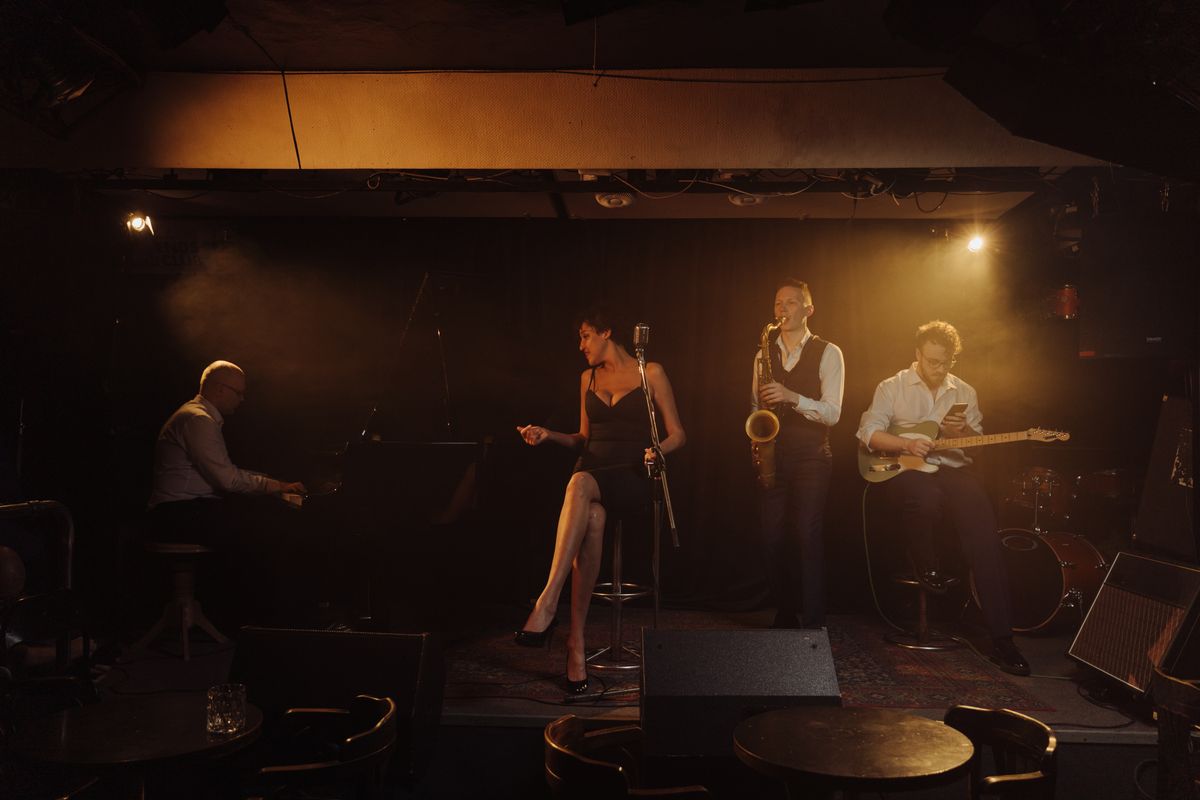
Jazz is not heritage in this city; it is a Tuesday. Chicago's jazz rooms still run real sets for real listeners, from a hundred-year-old Uptown landmark to a storefront on the North Side where the avant-garde works out its next decade. We have spent years of late nights in these rooms, and this guide to the jazz clubs in Chicago covers where to go, what it costs, where to sit, and how not to be the person who talks through the ballad.
The Green Mill: start here, obviously
The Green Mill Cocktail Lounge in Uptown is the most famous jazz room in Chicago and one of the most storied bars in America, operating on Broadway since the early twentieth century. The Capone-era lore is real enough, the favored booth, the stories about basement tunnels, and the room itself is a preserved dream: curved banquettes, murky golden light, a bar that has absorbed a century of secondhand smoke and gossip. But the Mill is not a museum. It books strong straight-ahead jazz week in and week out, the house acts have runs measured in decades, and the Saturday late sets can go deep into the night.
Practical intelligence: it is cash only at the door, and often inside, so hit an ATM first. Cover charges are famously reasonable for what you get. Weekends draw lines, so arrive well before the first set if you want a booth, and know that the room fills shoulder to shoulder by mid-evening. Sunday brings the long-running poetry slam, a different crowd and a different sport, worth experiencing once even if you came for the music.
Green Mill etiquette, a short sermon
The Mill enforces quiet during sets, and the bartenders will shush you, publicly, without embarrassment. This is not rudeness; it is the whole social contract. The deal the room offers is that a hundred people packed into a bar will actually listen, and in exchange the musicians play like it matters. Hold up your end. Order between tunes, keep your phone dark, and save the conversation for the break. People have been thrown out of the Green Mill for less, and frankly the ejections are part of what keeps it great. If you have never experienced a hundred-person bar going pin-drop quiet for a ballad at one in the morning, we can only tell you that it is worth every rule that makes it possible.
Andy's Jazz Club: the reliable downtown standby
Andy's Jazz Club, just off Michigan Avenue in River North, has been the Loop-adjacent workhorse of Chicago jazz for decades. It began as a newspapermen's bar and evolved into the city's most dependable listening room: multiple sets nightly, a full dinner menu, and a booking policy that favors swinging, accessible mainstream jazz over experiments. If you have visitors in town, a hotel nearby, or simply a Tuesday that needs rescuing, Andy's is the answer that never embarrasses you.
It runs on reservations more than most jazz rooms, and tables closer to the stage go first, so book ahead and specify. The dinner-and-a-set format means you can make an entire evening of it without moving, which we consider a feature. The kitchen is better than a jazz club kitchen needs to be, and the room's sightlines are generous almost everywhere.
Jazz Showcase: the listening room, purified
Jazz Showcase is the city's great shrine of straight-ahead jazz, founded by the late impresario Joe Segal in 1947 and still presenting national headliners in its South Loop room at Dearborn Station. This is the club where the portraits of the masters watch you from the walls and the music is the entire, explicit point: rows of seats facing the stage, a bar at the back, minimal chatter tolerated. When a touring legend comes through Chicago for a multi-night run, odds are this is where they set up.
Covers here run higher than the neighborhood bars, as they should, you are paying for names, and student discounts have traditionally softened the door for the young and broke. Sit close; the room rewards it. This is also the club we recommend to people who say they want to get into jazz. Two sets at the Showcase will teach you more than a year of playlists.
A great jazz room is a conspiracy between the band and the audience: everyone agrees to pretend the outside world closed early.
Constellation: where the adventurous nights live
Constellation, on the North Side near Roscoe Village, is the city's home for improvised music, the avant-garde, and everything jazz becomes when it stops worrying about the word jazz. Founded by a celebrated Chicago drummer, it programs fearlessly: free improvisation, new-music ensembles, artists from the city's deep experimental lineage that runs back to the AACM. The room is spare and intentional, closer to a black-box theater than a nightclub, and the audience listens with an intensity that borders on academic.
Go when you want to be surprised rather than soothed. Not every set will land for every listener, that is the nature of the enterprise, but the hit rate is far higher than newcomers expect, and there are nights at Constellation we still talk about years later. Tickets are typically inexpensive relative to the ambition on stage. Drink options are modest; nobody is there for the drinks.
The roots run through Bronzeville
A brief history stop, because the rooms above stand on deep foundations. Chicago jazz was forged on the South Side, in the Bronzeville of the 1920s and 1930s, when the Great Migration brought New Orleans players north and the neighborhood's theaters and ballrooms became the genre's proving ground. Louis Armstrong did career-defining work here. Earl Hines led his orchestra from a famous Bronzeville stage for years. The Regal Theater and the great dance halls of the Stroll made the South Side, for a stretch, the jazz capital of the world.
Most of those rooms are gone, and we will not pretend otherwise, but the lineage is not. It runs through the city's gospel and blues, through the AACM's revolution in the 1960s, and into the players you will hear on any given night at Constellation or the Hungry Brain. Chicago jazz has always been a working music, made by people with day jobs and church gigs and opinions. Knowing that history changes how the current rooms sound: less like preservation, more like continuation.
The jams and the small rooms
Beyond the marquee clubs, Chicago's jazz life runs on smaller rooms and late sessions. The Hungry Brain, up on Belmont, has hosted a beloved Sunday night series for years, an institution of the city's improvising community, in a room that is half dive bar, half clubhouse. The Whistler in Logan Square, better known as a cocktail bar, has long given bandstand time to serious players, no cover, with the crowd two deep at the bar. Winter's Jazz Club in Streeterville built a proper intimate listening room for straight-ahead swing, and Le Piano up in Rogers Park keeps a candlelit cabaret flame burning on the far North Side.
The late jam session is the connoisseur's move: musicians finishing paid gigs elsewhere drift in after midnight to play for each other. Schedules for these shift constantly, so the method is to ask, bartenders and band members will happily point you to where the players go after the gig. Some of our favorite nights in this city started as a tip muttered over a bar during a set break.
Covers, drinks, and the economics of listening
Money talk, because jazz clubs run on a fragile arithmetic. Covers in Chicago range from nothing at bar-first rooms to serious ticket prices for national acts at the Showcase or Constellation, with the Green Mill and Andy's usually in the modest middle. Two rules of honor apply everywhere. First, the cover is not the whole deal: buy drinks, tip well, the room's survival depends on the bar ringing. Second, never treat a no-cover set as background music; the band is being paid partly in your attention.
Drink culture varies by room and it pays to match it:
- Green Mill: classics and beer-and-a-shot simplicity; this is not the room for a complicated order mid-set.
- Andy's: full bar and dinner service, order freely, the room is built for it.
- Jazz Showcase: keep it simple and quiet; the music is the headliner, the bar is the supporting act.
- Constellation and the small rooms: modest lists, honest pours, nobody judging a soda water.
Seating strategy and timing
Arrive early everywhere, but for different reasons. At the Green Mill, early means a booth instead of a standing spot behind a pillar. At Andy's, early means the reservation slots near the stage. At the Showcase, the room is all seats, but the front rows change the experience; being close enough to hear the drummer's unamplified kit under the mix is the whole luxury. First sets tend to be politer and more crowded; late sets are looser, emptier, and frequently better, the band warmed up and playing for the diehards.
Weather is the secret variable in all of this, and late September is the sweet spot: cool enough that a warm room full of horns feels like shelter, not punishment, and early enough that the holiday-season crowds have not yet discovered their annual interest in jazz. The clubs feel most like themselves in the shoulder seasons, playing to rooms that came on purpose.
One more Chicago-specific note: these rooms cluster conveniently. The Green Mill sits amid Uptown and Andersonville drinking territory, Andy's is walkable from River North cocktail country, and the small North Side rooms make natural pairings with a pre-show or post-show stop. We map several of these pairings in our Chicago bar crawl routes, because a jazz set makes the perfect anchor for a night: it gives the evening a spine, and everything else arranges itself around it.
Making a full night of it
Our ideal jazz night, tested many times: an early cocktail somewhere with a serious bartender, one set at a listening room, then a slow landing at a bar with no stage at all where you can argue about what you just heard. The city is unusually well built for this. Half the pleasure of the Green Mill is stepping out afterward into Uptown with the night still young by Chicago standards, and half the pleasure of Andy's is that some of the city's best drink-makers, the rooms we cover in our guide to the best cocktail bars, are within a ten-minute walk.
And when the horns are packed up and you want the opposite of a listening room, the city obliges there too. Some of our favorite post-set landings are the no-cover, jukebox-run taverns from our tour of Chicago dive bars, where the music comes out of a machine, the lights are red, and nobody shushes anybody. Jazz first, dive after. That is the correct order, and by the end of the night you will understand why.
FAQ: Jazz in Chicago
How much does it cost to see jazz in Chicago?
Anywhere from free to real ticket money. Bar-first rooms like The Whistler often have no cover, the Green Mill and Andy's usually charge modest covers, and headliner rooms like Jazz Showcase and Constellation price like proper ticketed shows. Budget for drinks and tips everywhere; that is how the rooms survive.
Do I need reservations for the Green Mill?
The Green Mill has traditionally been first come, first served, and cash only, so the strategy is to arrive well before the first set, especially on weekends. Andy's and Winter's take reservations, and ticketed rooms like Jazz Showcase and Constellation sell seats in advance. Check each club's site for current policies.
Can I talk during a jazz set?
Quietly, between tunes, in the bar-style rooms; essentially not at all during the music at the Green Mill, Jazz Showcase, or Constellation. The Chicago convention is simple: the closer the room is to a pure listening room, the quieter you should be. When in doubt, follow the regulars.