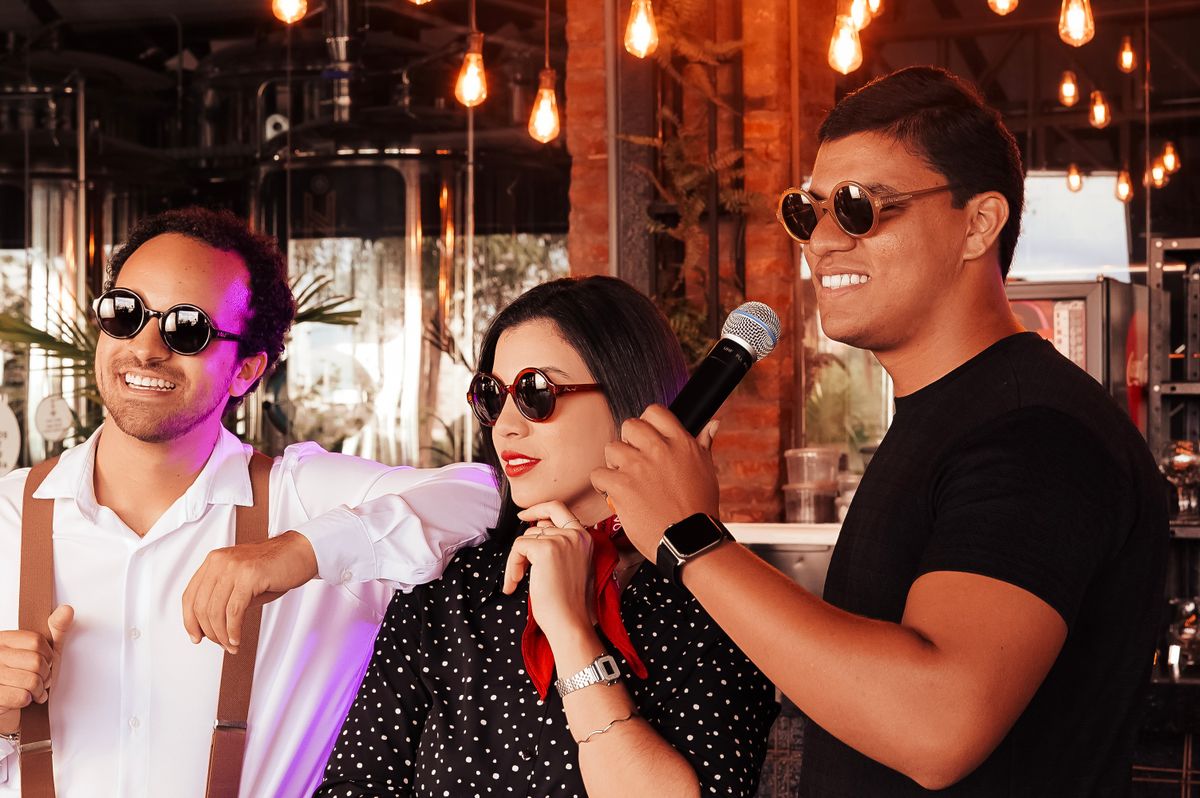
Karaoke bars in Chicago split into two great traditions, and knowing which one you want is half the night's planning. There is the private-room school, rented boxes where your group embarrasses itself in privacy, and the open-floor school, public stages where strangers become a congregation by the second chorus. We have sung badly in both for years. Here is how the city's singing rooms actually work, from booking logistics to song strategy to the morning after.
The Two Schools, Defined
Private-room karaoke, the KTV format that East Asia perfected, rents you a box by the hour: your group, your queue, your catalog remote, a couch, and a door that closes. The open-floor format is the American tavern version: one stage, one host with a binder or a tablet, and an audience of strangers who owe you nothing and will give you everything if you earn it.
The formats produce different nights. Private rooms are for groups, birthdays, coworkers, and anyone whose relationship with singing is still classified. Open floors are for extroverts, anniversaries of extroverts, and the specific magic of watching a quiet stranger detonate a ballad at half past midnight. Chicago runs both traditions deep, so choose deliberately. Mixing up the two is how a shy friend ends up in a fight-or-flight response holding a microphone.
The Private-Room Belt: Chinatown and the North Side
Chicago's KTV culture concentrates in two zones. Chinatown and its surroundings host rooms in the classic mold: long hallways of doors, catalogs that go extraordinarily deep in Mandarin, Cantonese, Korean, and English pop, snack menus, and hourly rates that get friendlier the earlier you start. The North Side, particularly the stretch of Lincoln Avenue where Korean-American nightlife has long thrived, runs its own belt of noraebang-style rooms, with Lincoln Karaoke a longtime anchor of the format.
First-timers are sometimes startled by how good the rooms are: real sound systems, tambourines, disco lights, service buttons that summon another round. The catalogs reward exploration far beyond the English-language hits. Our standing advice is to book the small room your group actually fills rather than the big one it rattles around in; karaoke, like soup, concentrates or dilutes depending on the container.
Group Logistics and Booking Windows
Private rooms are the rare nightlife format that rewards planning, so plan. Weekend prime time, roughly nine to midnight, books out at the popular spots, especially for the mid-size rooms that fit eight to twelve people. Call or book ahead by a few days for a Friday or Saturday; weeknights you can usually walk in and negotiate.
- Book by headcount honestly. Rooms are priced and sized by capacity, and fourteen people in a ten-person room is a sauna with a tambourine.
- Start earlier than feels cool. Early-evening hourly rates run cheaper, and two warm-up hours beat one frantic one.
- Appoint a queue manager. Democracy fails at karaoke; a benevolent dictator with the remote keeps rotation fair.
- Settle payment before the singing. Splitting an hourly room fee at one in the morning has ended friendships.
None of this is complicated, but every item on that list was learned the hard way, by us, on behalf of you.
BYO, Bottle Service, and the Fine Print
Policies on drinks vary more than any other detail in Chicago karaoke, so verify before you carry a tote bag of anything through a lobby. Some private-room venues run full bars and forbid outside alcohol entirely. Some sell bottles for the table at markup. A shrinking few tolerate outside bottles with a corkage-style fee, a practice that shifts with licensing and ownership, which is why we decline to publish a list that would be wrong within a year.
The safe assumptions: every venue would prefer to sell you the drinks, the snack menu is part of the economics, and staff goodwill is worth more than the savings on a smuggled bottle. Ask when you book, comply cheerfully, and remember that the room fee is buying you something scarce: a private stage in a major city, which, priced per person per hour, remains one of nightlife's genuine bargains.
Karaoke is the only nightlife format where the entertainment is you. Everything else, the room, the catalog, the second round, exists to lower the barrier between you and the microphone.
Alice's and the Open-Floor Faith
The open-floor tradition has its Chicago shrines, and Alice's is spoken of among devotees with genuine reverence: a no-frills North Side tavern where karaoke runs deep into the night, the hosts are institutions themselves, and the crowd operates on a strict etiquette of enthusiasm. Everyone gets cheered. The shaky first-timer gets cheered hardest. Regulars have been working through the catalog there for decades, and the room's lore includes performances people still describe like sporting events.
This is the format at its purest: no cover of note, no stage lights to speak of, just a rotation list and a shared agreement that sincerity beats skill. Arrive with a song in mind, put your slip in early because the rotation only grows, and buy a drink for whoever sang before you if they cleared the way with something brave.
Trader Todd's, the Tropical Institution
On the busier end of the open-floor spectrum sits Trader Todd's, the Lakeview tropical bar that has run karaoke essentially every night for what feels like geological time. Tiki decor, party-cruise energy, hosts who keep the rotation moving like air traffic control, and a crowd salted with bachelorette parties, birthday groups, and regulars who know the machine's every quirk.
It is loud, unpretentious, and shockingly effective at converting karaoke skeptics, because the room's energy does most of the work; a nervous singer at Trader Todd's is carried by sheer ambient goodwill. Weekend rotations get long, so file your song early and settle in. If your group contains both karaoke true believers and people who just want a drink and a show, this is the venue that satisfies both without negotiation.
The Late-Night Dive Circuit
Beyond the institutions runs Chicago's most charming karaoke layer: the weekly night at the neighborhood dive. Across the North and Northwest Sides, and in the late-hour bars that hold the city's four-o'clock licenses, karaoke surfaces one or two nights a week, hosted by traveling KJs with their own followings. These nights are unlisted-feeling, wonderfully uneven, and often the best story of the month.
Finding them takes minor scholarship, a glance at a bar's social feed or a chalkboard sighting, and the reward is karaoke at its least self-conscious. The crowd is the bar's normal crowd, which means the guy who has nursed the same stool since dinner might turn out to possess a startling falsetto. We keep a soft spot for this circuit above all the rest. It is the city singing to itself, no occasion required.
The Downtown After-Work Wildcard
One more subspecies deserves its entry: downtown karaoke, the after-work variant. Brando's Speakeasy in the Loop has long served the office crowd's secret ambitions, a dim room where paralegals and traders take the microphone with a commitment that would alarm their colleagues, sometimes starting remarkably early in the evening. The format sits between the two schools: an open floor, but with the intimacy of a small room and a crowd that arrived in business casual and shed it emotionally by the third song.
The after-work session has real advantages. It ends at a civilized hour, it catches people at peak articulation rather than peak volume, and it converts coworkers into humans faster than any team-building exercise ever invented. We have watched entire office hierarchies dissolve during one rendition of a nineties power ballad, and we consider this a public good. If your group cannot commit to a full night out, the early downtown session is the format's most underrated door. In late summer, when half the office is on vacation anyway, the rooms are looser and the rotation is short.
Song Strategy and Floor Etiquette
Decades of field research have produced firm doctrine. Pick songs the room can join by the chorus; karaoke is a participation sport disguised as a solo. Keep it under five minutes, and treat the ten-minute epic as the war crime it is: the rotation is long, and the host's mercy is finite. Know your range sober, because it shrinks two drinks in, and the key-change button exists for a reason.
- Open strong and familiar; save the obscure deep cut for a room that has earned your trust.
- Never sing over someone else's turn, and never touch an unattended microphone.
- Duets are a privilege, not a hostage situation. Confirm consent before dragging anyone up.
- Cheer the brave. The applause you give the shaky singer is the applause you will need later.
Follow the doctrine and any room in this guide will love you. Violate it and you will learn that Chicago karaoke crowds, though generous, have a long memory.
Singing Sober, and Other Radical Acts
A quiet truth of the format: karaoke is one of the best sober nights out this city offers. Private rooms in particular remove the drinking pressure entirely; the activity is the activity, the hourly rate does not care what is in your glass, and most venues pour teas, sodas, and increasingly respectable zero-proof options. Several groups we know book early-evening rooms precisely for this, all catharsis, no hangover.
Open floors work sober too, with a caveat: go early, when the crowd is warmer than it is wobbly. Daytime and early-evening rotations skew families, regulars, and serious hobbyists, which makes for better singing and better listening. If your circle includes people at different places with alcohol, karaoke is the rare nightlife plan that genuinely accommodates everyone without anyone performing restraint.
Birthday Planning, the Complete Playbook
Karaoke birthdays are a Chicago institution, and the playbook is settled. For groups of six to fourteen, book a private room for a two-hour block on the early side, then release survivors into the night. Collect song requests in the group chat beforehand, queue the birthday person's anthem third, never first, the room needs warming, and assign one deputy to guard the remote and another to guard the tab.
The second act is where planning pays. Rooms in our roundup of the best clubs in Chicago absorb the dance-floor faction, while the sports faithful can defect to a game at one of the venues in our sports bar guide without leaving the birthday's orbit. And because every karaoke night ends the same way, ravenous and hoarse at an hour when kitchens are scarce, we keep our map of late night food in Chicago current for exactly this moment. The birthday is not over until the fries arrive.
FAQ: Chicago Karaoke
How far ahead should we book a private karaoke room in Chicago?
For Friday and Saturday prime time, book several days ahead, especially for mid-size rooms fitting eight to twelve people; popular venues in Chinatown and along Lincoln Avenue fill their best slots first. Weeknights and early evenings are usually walk-in friendly. If your group is large or it is a birthday weekend, call the venue directly and confirm capacity and drink policy at the same time.
Is open-floor karaoke beginner friendly?
More than beginners ever believe. Chicago's open-floor rooms run on an etiquette of aggressive encouragement, and first-timers routinely get the loudest cheers of the night. Choose a familiar, singable song under five minutes, go earlier in the evening when rotations are short, and remember the audience is made of people who were nervous once too.
Can you do karaoke in Chicago without drinking?
Easily, and private rooms are the best format for it: the room fee is the product, nobody monitors your glass, and most venues offer sodas, teas, and zero-proof options. Early-evening open-floor sessions are also comfortable sober. Karaoke is fundamentally an activity night rather than a drinking night, whatever the second hour tends to suggest.