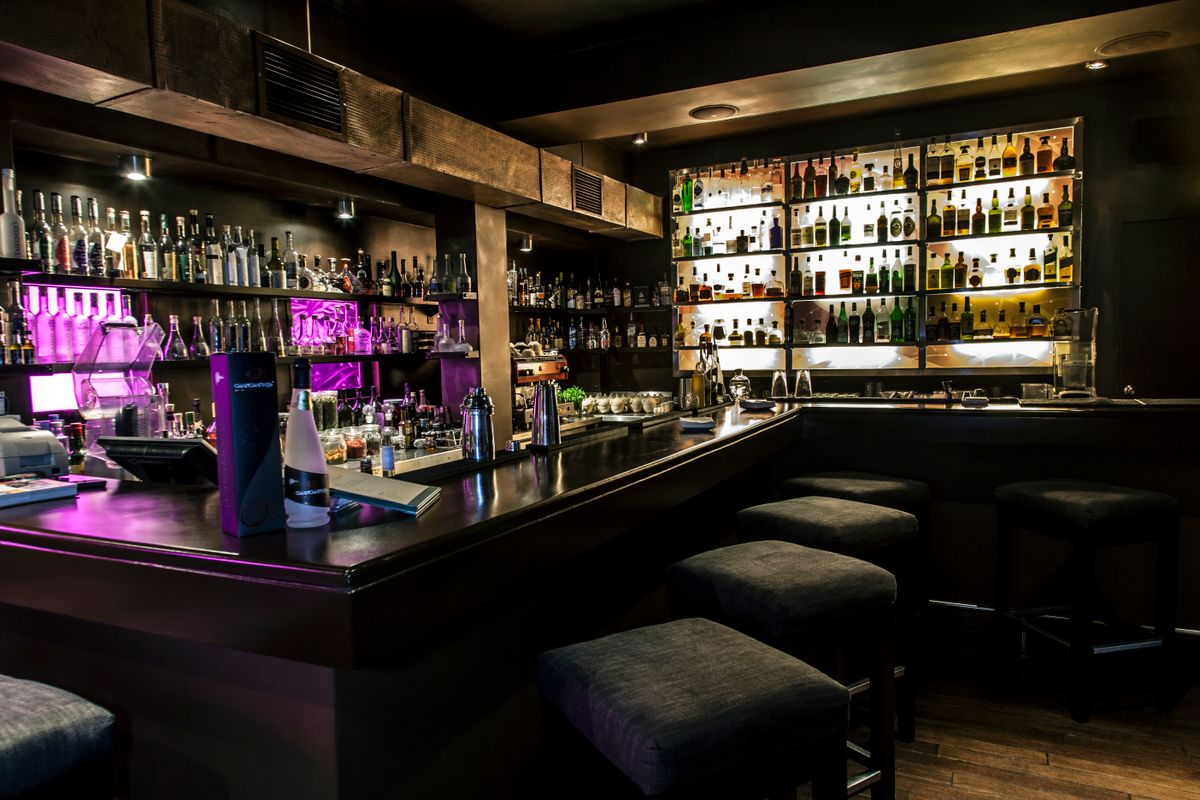
Logan Square bars have the best density-to-quality ratio in Chicago, and we do not say that lightly. Along Milwaukee Avenue and the boulevards that give the neighborhood its name, world-class tiki, amaro scholarship, gin obsession, whiskey-and-doughnut lore, and some of the most honest dives in the city sit within blocks of each other. This is our working map of the neighborhood, plus a four-stop route we would defend in court.
The Bar-Per-Block Thesis
Plenty of Chicago neighborhoods have one great bar. A few have three. Logan Square has a great bar roughly every block along its stretch of Milwaukee Avenue, and the range is the remarkable part: rooms with national reputations share corners with taverns that have not changed their prices, their jukeboxes, or their opinions in twenty years. The neighborhood absorbed a decade of cocktail ambition without evicting its old guard, which is rarer than it should be.
The geography helps. Milwaukee runs diagonal through the neighborhood, the wide green boulevards cross it, and two Blue Line stops pin the whole thing down. Almost everything worth drinking sits within a fifteen-minute walk of a train platform. That combination, quality plus density plus transit, is why Logan Square keeps appearing at the top of our lists, and why this guide runs long.
Lost Lake, the Tiki Standard
Start with the room that put the neighborhood on international best-bar lists. Lost Lake takes tiki seriously as a craft rather than a costume: a deep rum library, drinks built with the layered precision of fine cooking, banana-leaf wallpaper, and a permanent state of golden-hour lighting. It is small, it is beloved, and on weekends it fills accordingly.
What we appreciate most is that the fun is real but the rigor is realer. Order something with an absurd name and count the ingredients working; this is some of the most technical bartending in Chicago wearing a flower behind its ear. Go on the early side, put your name in if there is a wait, and use the interval to walk the boulevard. In late August, with the heat finally softening, a cold rum drink in that room is a seasonal rite.
Billy Sunday and the Amaro Deep End
Facing the square itself, Billy Sunday has spent years assembling one of the country's great collections of amari and hard-to-find bottles, some of them older than the building. The menu reads like a rare-books catalog for drinkers: bitter, herbal, strange, and rewarding in proportion to your curiosity. The room is handsome and unhurried, the kind of place where a nightcap becomes a seminar.
This is the bar we send people to when they say they are bored of cocktails. Tell the bartender what you usually drink and ask to be pushed one step past it; the staff excels at exactly that maneuver. It is named, with a wink, for the evangelist who preached Prohibition, which tells you the house has a sense of humor underneath the scholarship.
Scofflaw and the Gin Argument
Further northwest on Kedzie, Scofflaw made its name as the city's gin specialist back when gin was the spirit everyone claimed not to like. Fireplace, thrift-store elegance, a genuinely comfortable room, and a list that treats gin with the range it deserves, from bright and citrusy to deep and herbal. The kitchen's late-night cookie ritual has achieved minor legend status among regulars, and we will let you discover the details yourself.
Scofflaw matters in the neighborhood story because it proved the pattern: a serious cocktail room could thrive on a quiet corner far from downtown, priced for neighbors rather than tourists. Much of what makes Logan Square drinking great descends from that bet paying off.
Logan Square never chose between the twenty-dollar cocktail and the three-dollar beer. It just put them on the same block and let everyone commute between them.
Longman & Eagle, Whiskey and Lore
Few rooms carry more neighborhood mythology than Longman & Eagle, the whiskey-soaked inn on the square that helped announce Logan Square to the wider food world. The formula was audacious at the time: a serious kitchen, an encyclopedic whiskey wall with pours at every price, a no-reservations door, and a handful of rooms upstairs so the night technically never has to end.
The doughnut lore is real, by the way. The kitchen's morning pastries earned their own following, and the brunch line became a neighborhood institution in its own right. But we love it best in the evening: elbows on the bar, a rye in hand, the room loud with people who mostly walked there. If you have one night in Logan Square and want the whole thesis in a single address, this is the address, minus the address, because we do not print those.
The Whistler and the Free-Show Economy
No accounting of the neighborhood is complete without The Whistler, the little room on Milwaukee that doubles as an art gallery in its storefront window and has spent years running one of the city's best free live calendars: jazz nights, DJ sets, oddball bookings, all typically without a cover. The cocktails are serious, the room is tiny, and the whole operation runs on a generosity that would be a marketing gimmick anywhere else. Here it is just policy.
The Whistler matters as a thesis statement. It proved that a bar could be a cultural venue, a gallery, and a cocktail room at once, and charge nothing at the door for the privilege. Get there early on a night with music, because tiny means tiny, and the line forms with the neighborhood's usual patience. Estereo, up at the Milwaukee-Kedzie crossroads, extends the same open-hearted energy in a different key: Latin American spirits, windows that vanish in summer, and a room that seems permanently set to golden hour. Together they make the case that Logan Square's real signature is not any single drink but a certain lack of pretension about excellent things.
The Honest Dives
The cocktail rooms get the press; the dives keep the neighborhood honest. The Two Way Lounge on Fullerton is the standard-bearer, an old-school tavern where the beer is cold and cheap, the pool table is in use, and nobody performs anything for anybody. Places like this predate the boom and, with luck and patronage, will outlast it.
- Bring cash, or at least the attitude of someone who might.
- Order beer and a shot; elaborate requests are technically possible and spiritually wrong.
- Talk to the regulars if talked to. The dive is a commons, not a content opportunity.
Scattered along Milwaukee, Fullerton, and Armitage are more taverns of the same lineage, some Polish-rooted, some simply old. We keep their exact list a little loose on purpose. Half the pleasure of Logan Square is pushing open an unremarkable door and finding a room that has been perfectly itself since before you were born.
Middlebrow, Beer, and Pizza as a Worldview
Bungalow by Middlebrow, on Milwaukee toward the Avondale end, compressed the whole neighborhood ethos into one sunny package: a brewery obsessed with delicate, thoughtful beers, a bakery-grade sourdough pizza program, and a room that welcomes toddlers at six and dates at nine. The beer garden out front, when the weather cooperates, is one of the most pleasant places to spend a late-summer hour in the city.
Revolution's original brewpub, a longtime fixture further southeast on Milwaukee, holds down the bigger, boomier end of the local beer spectrum, and the neighborhood sits within easy reach of the city's larger taproom circuit, which we chart in our map of Chicago breweries. For a district this cocktail-famous, Logan Square drinks a remarkable amount of excellent beer, and nobody seems to find the contradiction worth mentioning.
Patios and the Boulevard Scene
Logan Square's boulevards, broad, green, and stitched together by the monument circle at the center, give the neighborhood a summer culture all its own. Parson's Chicken & Fish turned its lot into the city's benchmark patio, all picnic tables, negroni slushies, and fried chicken, with a wait on August weekends that functions as its own social scene. The farmers market takes over the boulevard on Sundays, and the whole neighborhood seems to circulate on foot or by bike.
Our late-summer counsel: build outdoor time into the front of the night, not the end. Patios in Chicago close earlier than bars, licenses being what they are, and the golden hour along the boulevard, with the monument catching the last light, is the neighborhood at its most persuasive. By the time it gets dark you want to be indoors somewhere with a good back bar anyway.
Blue Line Logistics
Two stops serve the neighborhood, and knowing which to use saves real walking. The Logan Square stop drops you at the monument circle, closest to Longman & Eagle, Billy Sunday, and the square itself. California sits further southeast down Milwaukee, handier for Lost Lake and the corridor toward Wicker Park. The line runs all night on the O'Hare branch, which makes closing time a logistical footnote rather than a crisis.
Between stops, Milwaukee Avenue is an easy, well-populated walk, and honestly the walk is part of the program: window menus, murals, taquerias still glowing at midnight. Cycling works well too, boulevards being generous, though we suggest an honest self-assessment before biking home from a rum bar. The neighborhood's whole design rewards leaving the car wherever it already is.
The Four-Stop Route
Asked for one perfect Logan Square evening, we prescribe this. Stop one: an early cocktail at Lost Lake, arriving near opening to beat the rush, one drink only, discipline matters. Stop two: dinner and whiskey at Longman & Eagle, eating at the bar if the wait demands it, which it will. Stop three: the deep cut, either amaro at Billy Sunday or gin by the fire at Scofflaw, depending on which direction your feet point. Stop four: a beer-and-shot landing at the Two Way, where the night decompresses to its natural pressure.
Adjust freely. Swap in a wine option from our tour of the city's wine bars if the group skews stemware; Webster's, the elder statesman of that scene, pours right in the neighborhood. And if the night refuses to die after stop four, the northwest side's singing rooms are cataloged in our guide to karaoke bars in Chicago, several within a short ride. We accept no liability for what happens there.
FAQ: Logan Square Bars
Which Blue Line stop is best for Logan Square bars?
Use the Logan Square stop for the monument circle cluster, including Longman & Eagle and Billy Sunday, and the California stop for Lost Lake and the southeastern stretch of Milwaukee Avenue. The two are a pleasant walk apart, and since the O'Hare branch runs all night, either works as your exit no matter where the evening ends.
Do Logan Square cocktail bars take reservations?
Mostly no; the marquee rooms run on walk-ins and waitlists, which is part of the neighborhood's egalitarian charm. Arrive close to opening for Lost Lake or Billy Sunday on weekends, put your name in, and drink or stroll nearby while you wait. Weeknights are dramatically easier and, in our opinion, the better experience anyway.
Is Logan Square expensive for a night out?
It spans the full range, which is the point. You can spend real money on rare rum and amari, or spend very little at the neighborhood's taverns, and most locals do both in the same night. Compared with downtown or River North, the marquee cocktails generally cost less and come with more care and fewer covers.