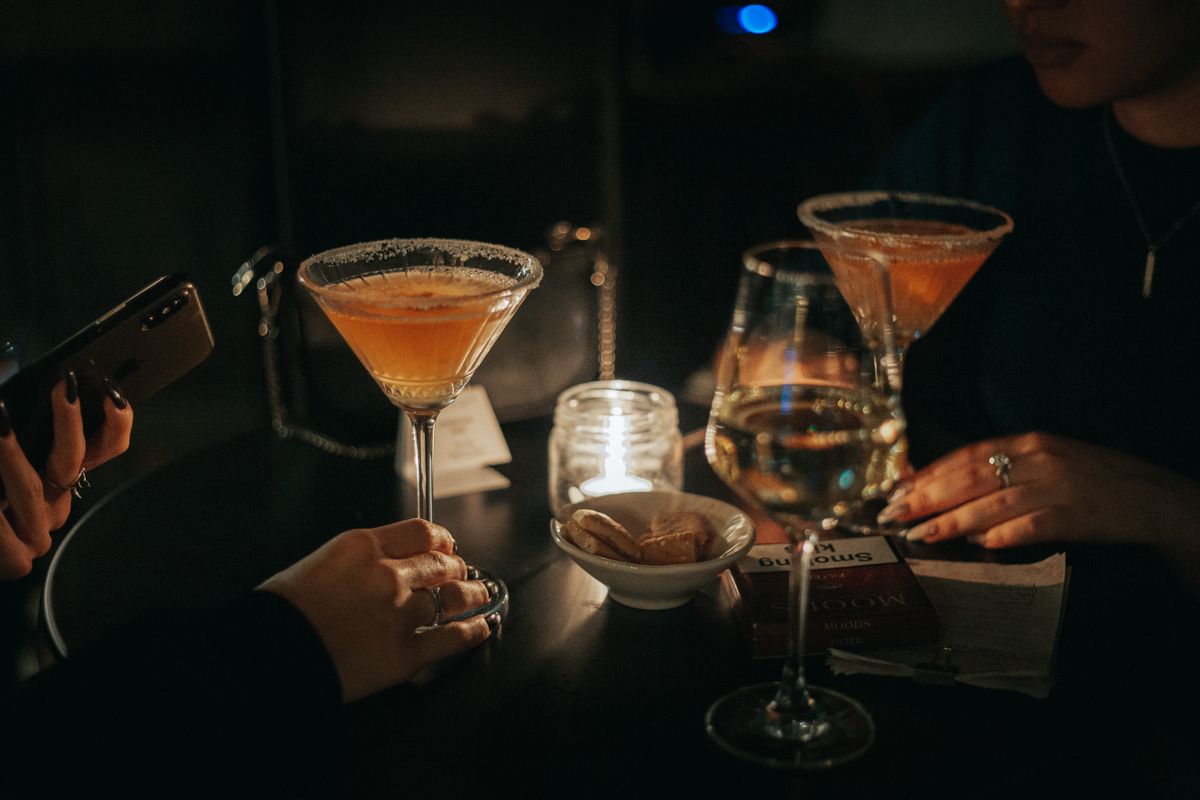
This one is personal. Encore began life as a lounge in the Loop, so we know exactly how much work goes into a room designed to feel like a secret. Chicago does the speakeasy better than any American city, partly because we invented the need for them, and partly because we never really stopped. If you are hunting for a speakeasy in Chicago, this guide covers the hidden doors, the reservation-only micro-bars, and the door policies that actually govern who gets in.
First, the history: Chicago earned this genre
Every city has bars behind fake bookcases now. Chicago has receipts. During Prohibition this town ran thousands of blind pigs and back rooms, and the infrastructure of secrecy, tunnels, false storefronts, side doors, was civic engineering, not theater. The Green Mill in Uptown is the living monument: a bar with genuine Capone-era lore, a favored booth with sightlines to both doors, and stories about the basement passages that every bartender will tell with slightly different details. It operates today as a jazz club rather than a hidden bar, but no speakeasy crawl is honest without paying respects there.
Up in Andersonville, Simon's Tavern keeps its own Prohibition-era stories alive, and Old Town's veterans will point you toward rooms whose names date to the era. The point is that in Chicago, the speakeasy is not a marketing concept imported from Brooklyn. It is local memory with a cocktail program attached. When a bar here hides its door, it is quoting its own grandparents.
The Violet Hour: the modern standard
The modern Chicago speakeasy era effectively begins with The Violet Hour in Wicker Park. Behind an unmarked, ever-repainted mural facade on Damen, it set the template when it opened: heavy curtains, high-backed chairs, candlelight, serious classic cocktails, and the famous house rules posted for all to read. No cell phone calls. No name-dropping. No star gazing, please.
People sometimes read the rules as pretension. Having run a lounge ourselves, we read them as staffing policy made public: the rules exist so that the room stays quiet enough to talk in, which is the entire product. The drinks remain among the city's best, the bartenders will steer you well if you tell them a spirit and a mood, and the wait on weekends is real. Go on a weeknight, early, and take the corner seats if the choice is offered.
Micro-bars and golden tickets: Milk Room and The Office
At the top of the reservation-bar pyramid sit two tiny rooms. Milk Room, inside the Chicago Athletic Association hotel on Michigan Avenue, is a former Prohibition-era speakeasy space reborn as a bar with only a handful of seats, pouring rare and vintage spirits in a space smaller than most kitchens. It books out, the tickets are not cheap, and the experience, drinking history by the quarter ounce, justifies itself at least once.
The Office sits beneath The Aviary in Fulton Market, behind an unmarked door, and getting in traditionally involves either a reservation or a well-timed request upstairs. Inside it is all leather, wood, and deep cuts from one of the most extraordinary spirits collections in the country. Both rooms share a philosophy: scarcity as hospitality. A bar with twelve seats can give you an evening that a bar with two hundred cannot.
Behind the record shop, behind the bordello curtain
Dorian's, in Wicker Park, hides behind a functioning record shop; you walk past the vinyl and through the back to find a plush, low-lit room with live music many nights and a menu that runs fancier than the entrance suggests. Buying a record on the way out is not required, but it is good manners, and their selection is genuinely decent.
Bordel, upstairs on Division Street, leans into a different fantasy: a dim, velvet-heavy parlor styled after a certain kind of establishment your grandmother warned you about, with burlesque and live acts on a regular calendar. It is theatrical in the best way, a room that commits to the bit. Between the two of them you can taste the range of the genre: Dorian's plays it cool and musical, Bordel plays it hot and dramatic.
The secret door is never really the point. The point is what a room can be when everyone inside it chose to look for it.
Basements, barbershops, and back rooms
The middle of the market is where the everyday speakeasy lives, the rooms you can actually get into on a Friday. A few favorites, grouped for efficient hunting:
- The Drifter, in the basement below the Green Door Tavern in River North, occupies a space with real Prohibition history. Cocktails arrive listed on tarot cards, and there is usually a variety act on the tiny stage: burlesque, magic, sword swallowing on a good night.
- The Library at Gilt Bar, also River North, is the candlelit book-lined basement under one of the city's most reliable dinner rooms. Not signed, not advertised, just downstairs.
- Blind Barber in the West Loop hides a full bar behind a working barbershop, an import of a proven formula that fits the neighborhood's after-work energy.
- Room 13 in Lakeview operates speakeasy-style inside the Old Chicago Inn, with a members-and-reservations flavor and a 1920s program played admirably straight. Check current arrangements before you go.
None of these requires winning a lottery. They require knowing they exist, which is the whole deal you signed up for by reading this far.
Hidden in plain sight: the tiki vault and the upstairs parlor
Two more that stretch the definition in worthwhile directions. Three Dots and a Dash in River North hides one of the country's great tiki bars down an alley and a staircase marked mostly by skull sconces; the entrance ritual is pure speakeasy even if the room inside is a party. Its inner bar-within-a-bar, a tiny rum vault with its own menu, is the deeper cut for spirits obsessives, and it books up fast.
Celeste on Wells Street stacks its secrets vertically: an ornate ground-floor bar, quieter and stranger rooms as you climb, and a garden up top that feels like a rumor even when you are standing in it. It is a good reminder that "hidden" in this city sometimes just means "upstairs, and nobody told you."
What to drink once you are inside
A hidden bar is a promise about the drinks, so hold them to it. Our standing advice in rooms like these: order a stirred classic first, a Manhattan, a martini, an old fashioned, because it tells you everything about the bar in one glass. Ice, dilution, temperature, balance: there is nowhere to hide in a three-ingredient drink. If the classic lands, hand the reins over. The phrase "bartender's choice" exists for exactly these rooms, and the best answers come when you give a real prompt: a base spirit, a direction, something you loved once.
Two more habits worth adopting. First, read the menu's deep end; reservation bars in particular tend to bury their most interesting work, the split-base experiments, the vintage pours, the house collaborations, below the crowd-pleasers on page one. Second, pace by rounds, not by hours. These menus run spirit-forward, the rooms are dark, and the seats are comfortable, which is a combination engineered to make a third drink feel like a first. Water between rounds is not weakness; it is how the professionals do it, and we say that as former professionals.
How door policies and reservation windows actually work
Some practical decoding, because the genre runs on soft rules that nobody writes down. Reservation-only rooms like Milk Room typically release booking windows weeks ahead; set a reminder and pounce, because the good slots go the first day. Hybrid rooms hold some walk-in seats even when the books look full, and a polite early arrival, right at opening, is the single most effective trick in the entire hidden-bar world.
At the door itself, the rules are simpler than they look. Speak quietly, know your party size, do not film the entrance. If there is a host, let them run the room; if there is a password or a gimmick, play along with good humor, the staff have done the bit ten thousand times and your enthusiasm is what keeps it fun for them. Dress codes are rarely posted and usually real: not formal, just intentional. And everywhere, the fastest way to be treated like a regular is to treat the bartender like a professional. Ask for a recommendation, give them a direction, trust the result.
The speakeasy spirit, city-wide
Once you start seeing it, the hidden-room instinct shows up all over Chicago nightlife. It is there in the jazz world, where the best sets happen in rooms that reward people who did their homework; our guide to jazz clubs in Chicago overlaps with this list more than once, starting with the Green Mill. It is there at the opposite end of the spectrum too, in the no-sign, cash-only taverns where the only door policy is the bartender's mood; our Chicago dive bar tour is, in its way, a speakeasy guide with the velvet removed.
And it is there in the city's split personality around drinking itself. This is the same town that throws the loudest, greenest, most public party in America every March, the river dyed and the streets packed, a spectacle we cover every year in our guide to St. Patrick's Day in Chicago. The hidden bars are the other half of that personality: the city that knows how to keep a secret precisely because it knows how to make noise. You need both. September, for what it is worth, belongs to the quiet half.
Building your hunt
A suggested route for the committed: start early at The Library at Gilt Bar or The Drifter in River North, where walk-ins are realistic. Head west for the heart of the night, Dorian's or The Violet Hour depending on whether you want music or murmur, with Bordel as the late escalation. Save the reservation rooms, Milk Room and The Office, for their own dedicated evenings; they are not stops on a crawl, they are destinations.
A word on company: these rooms are conversation machines, so choose your party accordingly. The ideal speakeasy group is two to four people who actually like talking to each other; a bachelorette flotilla of nine will spend the night being politely split up and seated in shifts. If you must go big, call ahead, some rooms can arrange it, and the ones that cannot will tell you honestly.
Two closing notes of practicality. First, hours and entry procedures in this genre change constantly, unmarked doors are also unmarked when they close early, so check each bar's site or socials the same day. Second, pace yourself; these menus run strong and the rooms run dim, a combination that has surprised sturdier drinkers than you. The whole point of a hidden bar is to be present in it. Arrive curious, leave while you can still keep the secret. And if you find a door we have not listed here, do the honorable thing: tell almost no one.
FAQ: Chicago speakeasies
Do Chicago speakeasies require passwords?
Mostly no. A few rooms use light theater at the door, and reservation-only bars like Milk Room simply require booking ahead. For most hidden bars, Dorian's, The Drifter, The Library at Gilt Bar, you just need to know where the entrance is and arrive at a reasonable hour.
What was a real speakeasy in Chicago during Prohibition?
The Green Mill in Uptown is the most famous surviving example, with genuine Capone-era history, and spaces like the basement below the Green Door Tavern and the room that now houses Milk Room also date to the era. Thousands of others operated across the city and vanished when Prohibition ended.
How far ahead should I book a reservation-only bar?
For tiny rooms like Milk Room or The Office, watch for the reservation window to open, often several weeks out, and book immediately, especially for weekend slots. For everywhere else, a same-week reservation or an early walk-in on a weeknight is usually enough.